




Gwen V. Childs, Ph.D.,FAAA
Formerly Gwen C. Moriarty, Ph.D.
Professor and Chair, Department of Neurobiology and Developmental Sciences; University of Arkansas for Medical Sciences, Little Rock, AR
Email Contact: Work or Personal
The research in my laboratory is focused on the regulation of specific anterior pituitary cells by neuroendocrine peptides and growth factors. Most recently, we are focused on the role of leptin in the regulation of pituitary gonadotropes and somatotropes. We have received National Institute of Health and National Science Foundation funding and are currently supported by R01 HD059056-05
What's new at this site?
- Updated CV
- Honors (since 2000)
- h-index calculation (August 2015)
- Press Releases
- ResearchGate STATS
- Updated page for in situ hybridization.
CAMPUS ADDRESS:
Gwen V. Childs, Ph.D., FAAA
Professor and Chair
Department of Neurobiology and Developmental Science
College of Medicine
University of Arkansas for Medical Sciences
4301 W. Markham St; Slot 510
Little Rock, AR, 72205
(501) 686-7020
web page: www.cytochemistry.net/childs/Childs.htm
Email: Work or Personal
Summary of Training and Academic Positions
- 1966: B.A., Biology, Whitman College, Walla Walla, Washington.
- 1972: Ph.D., Anatomy, University of Iowa, Iowa City, Iowa
- 1972: Assistant Professor of Anatomy, University of Nebraska Medical Center, Omaha, Nebr
- 1976: Associate Professor of Anatomy, Northwestern University College of Medicine, Chicago, Ill
- 1981-April, 2000: Professor of Anatomy, University of Texas Medical Branch, Galveston, TX
- 1992-2000: Vice-Chair, Department of Anatomy and Neuroscience
- 1992-2000: Program Director, Cell Biology Graduate Program at the University of Texas Medical Branch
- 1997-March, 2000: Coordinator, Basic Science Core, (New) Integrated Medical Curriculum, University of Texas Medical Branch
- April, 2000: Professor and Chair, Department of Neurobiology and Developmental Sciences, University of Arkansas for Medical Sciences
Note: I began my academic life as Gwen Childs Moriarty. My publications from 1972-1977 are authored by Gwen C. Moriarty.
State and National Committee or Consulting Service
- Texas State Coordinating Board "Health Professions Education Advisory Committee"
- 1995-2000 National Institute of Health, Population Research Subcommittee (Study Section), National Institute of Child Health and Human Diseases.
- 1996-2000 Histochemistry
Society
- Councilor 1996-1999; Webmaster 1997-2000, Histochemistry Society Web Site
- President-elect 1999-2000,
- President 2000
- 1995-1999 The Endocrine Society Chair, Membership Committee,
- 2000-2004 Endocrine Society Development Committee
- 2006-2011 American Association of Anatomy, Cell Biology and Neurobiology
Chairs (AACBNC):
- Council 2006-2008;
- President elect 2000
- President 2010
- 2011--2013 South Regional Representative and member of the Board of Directors, Society for Executive Leadership in Academic Medicine (SELAM International).
- 2014-2018 Study section—Reproduction, Andrology and Gynecology Study section.
Honors (since 2000)
- Distinguished Teacher Award, Graduate School of Biomedical Sciences,
- University of Texas Medical Branch, 2000
- Innovations in Education Award, College of Medicine, University of Arkansas for Medical Sciences, 2004
- Runner up, Golden Apple Award, Freshman Class, 2007
- Red Sash award, Sr. Class, 2006, 2007, 2008, 2009, 2010, 2011
- Gold Sash Award, Sr. Class 2009, 2010, 2011
- Outstanding Woman Faculty award, Woman's Faculty Development caucus, UAMS. 2009
- Fellow of the American Association of Anatomists (FAAA) 2011--
- Listing of current Fellows
- Press Release
h-index calculation (August, 2015)
- The h-index as of August, 2015 shows, that I have 45 publications that have received 45 or more citations with an average of 30 citations per publication.
- When abstracts in the list are omitted, the average increases to 35.7 citations per paper.
- Our papers have been cited 6006 times; 5067 citations are from other authors.
- 3/17/2009: UAMS Press Release
- Gwen Childs named outstanding woman faculty http://www.uamshealth.com/?id=4583&sid=1
- 12/2/2010: UAMS Press Release regarding publication (pdf file)
- UAMS Researcher Finds Genetic Link to Obesity (Discovery published in Endocrinology)
- KARN and KUAR radio stations have aired taped interviews with Dr. Childs.
- CBS, Channel 11 news (local) Interview and online article and Video
- KARK NBC news broadcast: Genetic Link to Obesity Found by UAMS Researcher
- ABC local news: Study Finds Possible Link To Obesity
- Fox news: Obesity Hormone
- MDLinX editorial commentary: The Somatotrope as a Metabolic Sensor: Deletion of Leptin Receptors Causes Obesity
- 12/10/2010: Endocrine News article describing the paper published in
Endocrinology, Jan 2011
- Endocrine news article is on page 16 of this pdf
- Also see full issue at http://www.endo-society.org/endo_news/2010/upload/Endocrine-News-December-2010.pdf
- 3/16/2011: Press release to announce Dr. Childs' selection as Fellow of the American Association of Anatomists (FAAA).
- April, 2013. Editorial Comment on our paper by Syed et al. by Buffy S Ellsworth--http://dx.doi.org/10.1210/en.2013-1159
ResearchGate Statistics
- RG score: August 6, 2015: 42.34
- Total impact: 647.84
- 100-150 Publication downloads/week since June, 2015
- 63-159 Publication views/week since June, 2015
- ResearchGate Site for Gwen Childs
Specific Projects
- Dynamic changes in gonadotropes during the reproductive cycle.
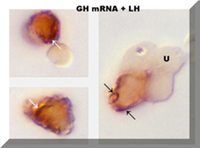
- Are growth hormone cells co-gonadotropes?
- The effects of epidermal growth factor on pituitary corticotropes and gonadotropes.
- The effects of stress on the expression of pituitary epidermal growth factor .
- Regulation and secretion of pituitary nerve growth factor
- Stimulus secretion coupling in corticotropes: role of ion channels in signaling
- Significance and regulation of Anterior pituitary leptin to the reproductive system (page under construction)
- Regulation of monohormonal gonadotropes, expressing only one beta subunit mRNA (page under construction)
- Significance and regulation of anterior pituitary leptin
- Significance of leptin receptors on pituitary somatotropes and gonadotropes.
Graduate Students 1994- Present
- James Patterson (M.D. Ph.D. student; completed Ph.D in 1994) Now doing a residency in Psychiatry at the University of Texas Medical Branch.
- Xuemo Fan (completed Ph.D. in 1994)
- Jennifer Armstrong (completed Ph.D. in 1997)
- Jiangang Xie (completed Ph.D. in 1998)
- Iris MacDuffie (M.S. student in Nutrition at UAMS)
- Mary Iruthayanathan, M.D. (completed Ph.D. in 2006)
- Chris Crane, M.S. (Master's program; Honors Medical Student; Completed MD in 2010
- Zachary Brodrick, M.S. (MS, completed in 2008, MD Completed in 2013).
- Angela Odle, Ph.D. (Ph.D. Completed in 2014)
- Melody Allensworth (Ph.D. Program, 2011-present)
Special techniques used in laboratory
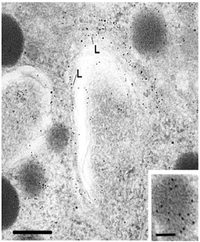
- Immunogold cytochemistry for detection of hormones and growth factors
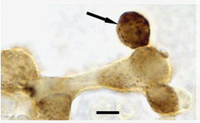
- Affinity Cytochemistry for detection of receptors
- In situ hybridization to detect messenger RNA
- Dual labeling for detection of receptors or mRNA and antigens (or two antigens)
- Centrifugal elutriation to enrich and purify pituitary corticotropes gonadotropes, and growth hormone cells.
- siRNA silencing of pituitary leptin. Transfection of primary pituitary cell cultures
- Cre-loxP technology applied to selectively knockout genes in gonadotropes or somatotropes. Deletion mutants of leptin receptors are now being produced.
We also use more routine technology like electron microscopy, cytology, radioimmunoassay, image analysis, enzyme immunoassay, and tissue culture. Most molecular biology techniques such as qRT-PCR, RNA and DNA extraction, genotyping are ongoing in core facilities.
This form of the original page went online: 10/23/00
For more information, contact:
Gwen Childs, Ph.D.,FAAA
Professor and Chair
Department of Neurobiology and Developmental Sciences
University of Arkansas for Medical Sciences
Little Rock, AR 72205
For questions, contact this email address:

